
Frameworks
Universal Business Framework
Ten components, from an industry down to a single project, and a five-step path for launching and scaling droids.
The Universal Business Framework, UBF for short, is how WE describes business: the way astronomy describes the sky. An industry is a galaxy. A holding company and the companies around it form a solar system. A company is a world, and a project that sets out with one purpose is a droid. Seen this way, a new project has neighbors, dependencies and a place on a map.
WE wrote UBF for its own use, and it is the map the other WE frameworks sit on. It is a working method, not an industry standard. It has not been independently evaluated, and WE does not claim that using it produces any particular result. Its value is shared language: when a founder and the team say where a piece of work sits, everyone sees the same picture.
WE makes no promise of funding, and nothing on this page predicts that a company will raise money.
The planetarium
Ten components, one sky
Every body in the UBF sky stands for something real in business, from a whole industry at the outer edge to an unstable project close in. Select a body to read what it means and how WE uses it with a founder.
Industry, ecosystem, company, project: the map works at every scale.
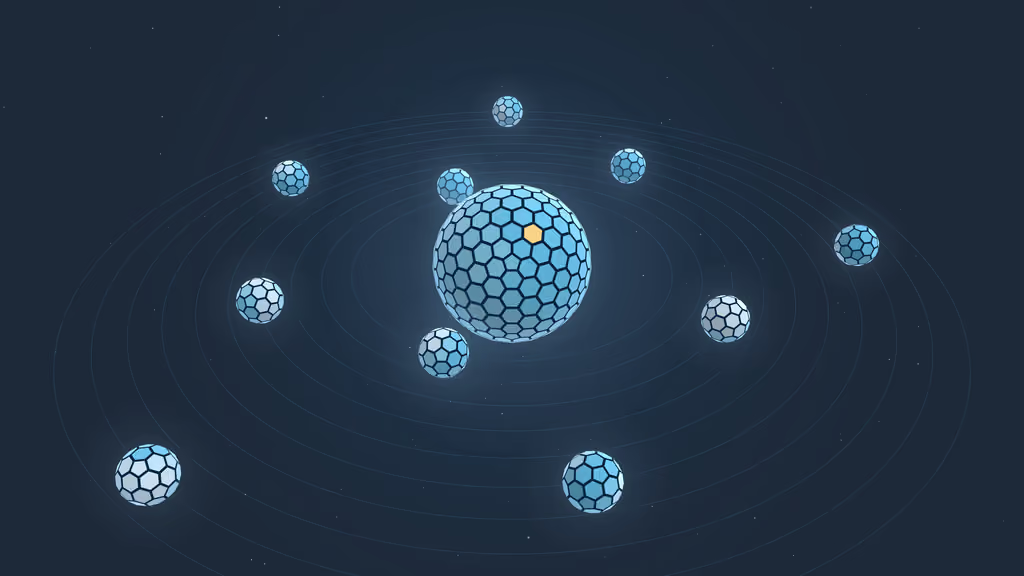
- Galaxy An entire industry.
- Black Hole The giant at the center.
- Super Nova An event that shifts the industry.
- Solar System A holding company and its ecosystem.
- Sun The center of a system.
- Super Star A flagship with room to grow.
- Star A small company or project.
- Moon A side project or department.
- Comet An unstable project to re-plan.
- Asteroid An unstable project to avoid.
The ten components
Definitions quoted from WE's framework documents, and what each one means once the work starts.
-
Galaxy
Industry
“An entire industry, defined by a NAICS Code”: the companies, organizations and stakeholders that offer similar products and compete for the same customers.
In an engagement: WE maps the industry a company lives in before planning the work: who is there, how they connect and how the field is changing.
-
Black Hole
Industry
“A large corporation at the center of a galaxy, exerting a powerful gravitational force” on subsidiaries, competitors and new ideas.
In an engagement: A plan says how the company stays clear of the giants, or works with them, instead of pretending they are not there.
-
Super Nova
Industry
“A corporate cosmic-shifting event”: a major merger or acquisition, a regulatory change or a technological breakthrough.
In an engagement: Reviews ask what has shifted in the industry since the last one and what that changes for the plan.
-
Solar System
Ecosystem
“Holding companies within a galaxy, organized by their size, market share, and SIC Codes”, together with their suppliers, customers and competitors.
In an engagement: WE looks at the ecosystem a company depends on: suppliers, partners, customers and the companies it sits beside.
-
Sun
Ecosystem
“The largest publicly visible companies within a Solar System or the headquarters of an organization”: the hub of activity and influence.
In an engagement: In an engagement the company is the sun. The team, the plans and the reviews orbit it, and the founder keeps every decision.
-
Super Star
Company
“Flagship or role model companies that have the potential to become Suns.”
In an engagement: The flagship product or line the company is built around, given the most attention as it grows.
-
Star
Company
“Small companies or projects defined by the S.M.A.R.T. S.T.A.R. framework.”
In an engagement: Each piece of work is written to be Specific, Measurable, Achievable, Relevant and Time-bound, then reported through Space, Track, Assist and Reach.
-
Moon
Project
“Orbital, side projects, startups, subsidiaries, or departments”, each defined with the O.R.B.I.T.A.L. framework.
In an engagement: A side project gets its own O.R.B.I.T.A.L. plan: objective, resources, budget, indicators, transport, activities and logistics.
-
Comet
Project
An unstable project “that requires better planning”.
In an engagement: When a project drifts, the team says so in writing and re-plans it before it uses more of the company’s time.
-
Asteroid
Project
An unstable project that “requires avoidance”: a risk to the company if it is taken on.
In an engagement: Some work should not be started at all. WE says so, and the reason goes into the written record.
How the parts nest
A galaxy holds its giants, its shifts and its solar systems. A solar system turns around its sun. The sun holds the flagship, the small companies and projects, and the unstable ones that need a decision. A moon circles the flagship it serves.
From droid to galaxy
-
Droid
A project, launched with one purpose.
-
World
A company the project grows into.
-
Solar system
A group of companies around a center.
-
Galaxy
An industry those groups shape.
- Galaxy An entire industry.
- Black Hole The giant at the center.
- Super Nova An event that shifts the industry.
- Solar System A holding company and its ecosystem.
- Sun The center of a system.
- Super Star A flagship with room to grow.
- Moon A side project or department.
- Star A small company or project.
- Comet An unstable project to re-plan.
- Asteroid An unstable project to avoid.
- Super Star A flagship with room to grow.
- Sun The center of a system.
Launching and scaling droids
Five steps, three stages
UBF sets out five steps for taking a project from an idea to a place in its ecosystem. WE runs them inside its three stages: WE Dream, WE Build, WE Grow.
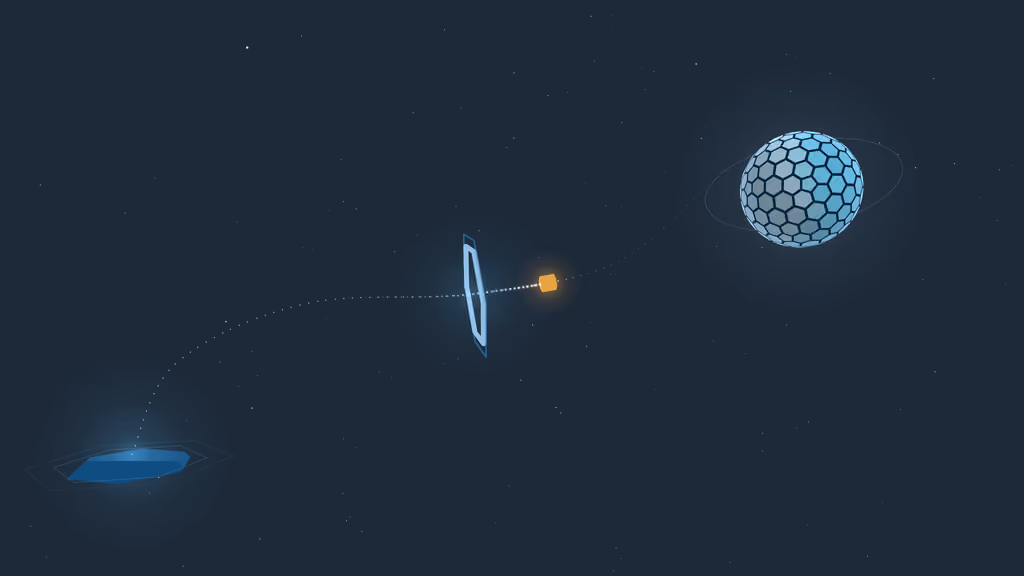
- Dream Survey: validate the problem
- Build Blueprint: ship the product
- Grow Territory: earn customers
- 1. Ideation and conceptualization WE Dream
- 2. Planning and resource allocation WE Dream
- 3. Execution and monitoring WE Build
- 4. Scaling and growth WE Grow
- 5. Integration and ecosystem management WE Grow
WE Dream
Test the idea and write the plan.
- Step 1: Ideation and conceptualization Generate the idea, research the market and test whether it is feasible. A star ignites.
- Step 2: Planning and resource allocation Write the plan: timeline, budget, people and the risks to manage. O.R.B.I.T.A.L. rings are drawn around the launch pad.
WE Build
Carry out the plan and watch it closely.
- Step 3: Execution and monitoring Carry out the plan, watch the indicators and resolve issues as they come. Lift-off, tracked from Mission Control.
WE Grow
Widen what works and join the ecosystem.
- Step 4: Scaling and growth Judge what worked, then widen the resources and the market. Orbit insertion: a star grows into a super star.
- Step 5: Integration and ecosystem management Join the wider ecosystem and keep improving the relationships it runs on. A world settles into its solar system, with its moons.
Ten levels where Agile has five
Agile breaks a project into five pieces, from an initiative down to a task. UBF keeps those pieces in view and adds the larger picture: the industry, the ecosystem and the company the project lives in.
The two work together. A team can plan its sprints in Agile terms while UBF says where the work sits on the map.
Agile 5 levels
The pieces of one project.
- Initiative
- Epic
- User story
- Feature
- Task
UBF 10 levels
From an industry down to a single project.
- Galaxy
- Black Hole
- Super Nova
- Solar System
- Sun
- Super Star
- Star
- Moon
- Comet
- Asteroid
In an engagement
How WE applies it with a founder
The map is not a deliverable. It is how WE plans the work and talks about it with the founder, from the first review to every checkpoint after it.
-
Map the galaxy
Before planning the work, WE maps the industry the company lives in: the giants at its center, the recent shifts and the ecosystem the company depends on.
-
Put the company at the center
The company is the sun of its own system. The team WE steers, the plans and the reviews orbit it, and the founder keeps every decision.
-
Choose the flagship
One product or line carries the company first. It gets the most attention, and the plan says why it was chosen.
-
Write every piece of work as a star
Each task is written to be Specific, Measurable, Achievable, Relevant and Time-bound, then reported through Space, Track, Assist and Reach.
-
Plan each side project on its own orbit
A side project or a department gets its own O.R.B.I.T.A.L. plan, so it can grow without pulling the company off course.
Bring your company onto the map
A readiness review is the first conversation. WE looks at where the company sits and what the next stage needs.